

China Top Mine Exhaust Fans Manufacturers and Suppliers
China has become an important sourcing base for Mine Exhaust Fans used in underground and surface ventilation systems. Manufacturers and suppliers serve coal, metal, non-metal, and tunneling projects. Their product ranges often include axial-flow, centrifugal, portable, and explosion-resistant ventilation equipment. Each design responds to different airflow, pressure, temperature, and installation requirements.
Performance starts with accurate project data. A reliable supplier should review tunnel length, ventilation resistance, gas conditions, operating hours, and available power. Product discussions should include airflow volume, static pressure, motor efficiency, impeller balance, vibration levels, noise control, and corrosion protection. A fan may look powerful on paper. It can still perform poorly after installation. That detail matters.
Experienced manufacturers usually support fan selection with engineering calculations, factory testing, inspection records, and installation guidance. Buyers should request performance curves, motor specifications, material details, quality certificates, and maintenance recommendations. Factory visits or independent inspections can add useful confidence. So can references from comparable mining projects.
No supplier is perfect. Catalog figures may not reflect field conditions. Some quotations also hide important costs, such as controls, spare parts, transport, or commissioning. Careful buyers should compare complete solutions instead of comparing prices alone. This guide examines China’s Mine Exhaust Fans manufacturers and suppliers through product capability, customization, quality control, delivery reliability, and after-sales support. The goal is practical selection, not promotional claims. Ventilation decisions deserve evidence.
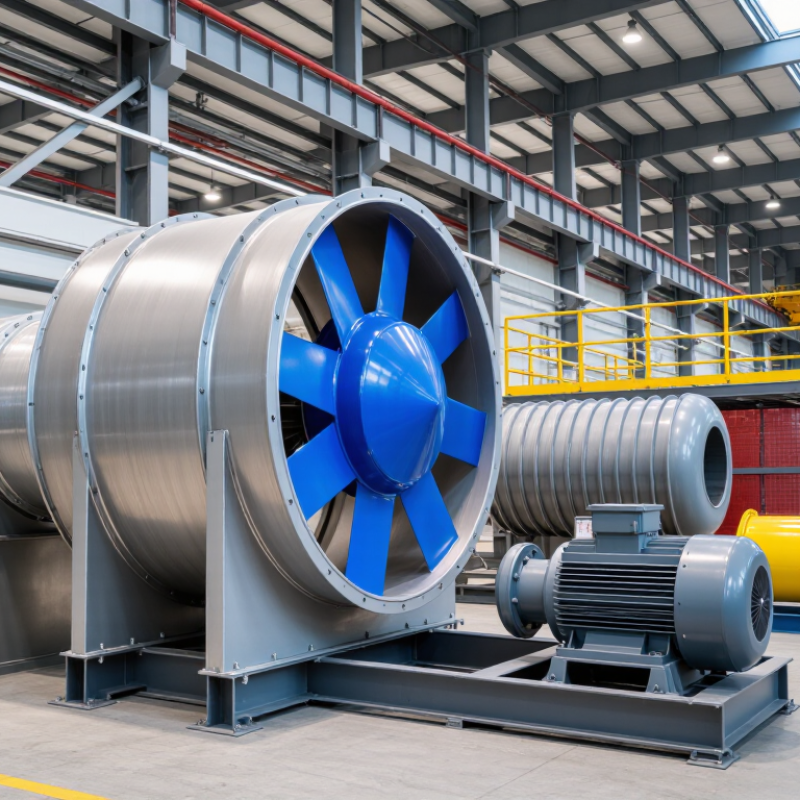
Types of Mine Exhaust Fans Manufactured in China
Chinese manufacturers produce several mine exhaust fan types for underground and surface ventilation systems. Axial-flow fans are common because they move large air volumes through relatively compact housings. Their adjustable blades can support different airflow demands. Some models include reversible rotation for emergency ventilation changes. That flexibility matters underground.
Centrifugal mine fans suit systems requiring higher pressure. Their backward-curved or airfoil blades help overcome resistance from long ducts, bends, and filters. They are often selected for main exhaust stations. Heavy steel casings, vibration monitoring, and balanced impellers support continuous operation. Small auxiliary axial fans serve working faces, headings, and temporary duct lines. They usually connect to flexible ventilation ducts.
Variable-frequency drive systems allow operators to adjust airflow without constant mechanical changes. However, energy savings depend on correct commissioning and clean intake conditions. A dirty inlet can reduce performance quickly. It is an overlooked detail. Chinese suppliers commonly provide factory airflow testing, noise checks, insulation measurements, and dynamic balancing. Buyers should request test curves, material specifications, motor protection details, and maintenance instructions. Reversible operation also needs careful verification, since reverse airflow may not match forward capacity. The design may look suitable, yet field conditions can expose gaps. Proper selection still requires mine depth, duct length, gas-control requirements, temperature, and local safety standards.
| Mine Exhaust Fan Type | Operating Principle | Typical Airflow Direction | Pressure Capability | Common Mining Application | Main Drive Arrangement | Typical Configuration Features |
|---|---|---|---|---|---|---|
| Axial-Flow Main Mine Fan | Air is moved parallel to the rotating shaft by aerodynamically shaped blades. | Axial, generally straight through the fan casing. | Medium to high pressure, depending on blade angle, impeller diameter, and operating speed. | Primary ventilation of underground mines, shafts, declines, and large airways. | Direct-coupled motor or motor with a flexible coupling. | Reversible airflow options, adjustable-pitch blades, inlet bell, diffuser, silencer, and vibration monitoring. |
| Centrifugal Main Mine Fan | Air enters the impeller axially and leaves radially after gaining velocity and pressure. | Air typically enters axially and exits through a radial discharge outlet. | High pressure capability and stable performance against system resistance. | Deep mines, long ventilation networks, and systems requiring substantial resistance handling. | Direct drive, belt drive, or coupling drive. | Backward-curved or backward-inclined impellers, scroll casing, access doors, and outlet transition sections. |
| Auxiliary Ventilation Fan | Supplies or exhausts air through flexible or rigid ventilation ducting. | Axial flow through a duct-connected casing. | Designed for the pressure loss of headings, ductwork, bends, and auxiliary equipment. | Development headings, blind tunnels, construction faces, and localized underground work areas. | Electric motor, commonly mounted within or beside the fan assembly. | Compact housing, duct connectors, portable skids, protective guards, and staged fan installation. |
| Forced-and-Exhaust Dual-Purpose Fan | Supports either forced ventilation or exhaust ventilation according to the selected system arrangement. | Direction depends on duct connection and fan rotation or blade setting. | Selected to overcome the resistance of the connected ventilation circuit. | Flexible ventilation layouts where the same equipment may be used for supply or return air service. | Direct drive or coupling drive with suitable motor controls. | Reversible design, robust casing, directional airflow markings, and adaptable duct interfaces. |
| Reversible Axial Mine Fan | Uses an axial impeller and an airflow-reversal arrangement to change the ventilation direction. | Forward or reverse axial flow. | Pressure and efficiency can differ between normal and reversed operation. | Emergency ventilation, fire or smoke control strategies, and mines requiring operational airflow reversal. | Direct-coupled or coupling-driven motor with electrical reversing control. | Reversible impeller, symmetric casing sections, controlled start-up, and clearly defined operating limits. |
| Explosion-Protected Auxiliary Fan | Provides localized ventilation while reducing ignition risks in potentially hazardous underground atmospheres. | Usually axial flow through a connected duct system. | Matched to the pressure loss of the auxiliary ventilation circuit. | Coal mines and other areas where combustible gas or dust hazards may be present. | Certified explosion-protected motor with guarded electrical components. | Anti-static or flame-resistant duct compatibility, protected terminals, grounding provisions, and safety interlocks. |
| Jet Fan for Tunnel or Mine Ventilation | Creates a high-velocity air jet that induces and propels surrounding air without a long duct connection. | Axial discharge along the tunnel or airway. | Produces thrust rather than only static pressure in an open airway. | Large underground openings, transport tunnels, cavern ventilation, and smoke-control systems. | Reversible electric motor with direct drive. | High-velocity nozzle effect, suspension brackets, acoustic treatment, protective casing, and optional reversal control. |
| Two-Stage Axial Mine Fan | Uses two impeller stages in series to increase pressure while maintaining axial airflow. | Axial flow through both impeller stages. | Higher pressure capability than a comparable single-stage arrangement. | Long duct runs, deep mine workings, and ventilation systems with high resistance. | Single motor with mechanically connected stages or separate staged drive arrangements. | Multi-stage impeller assembly, guide vanes, inspection access, and vibration monitoring points. |
| Variable-Frequency-Controlled Mine Fan | Fan speed is adjusted electronically to match required airflow and system resistance. | Axial or centrifugal, depending on the selected fan design. | Operating pressure varies with speed and system conditions. | Energy-conscious mine ventilation, changing production zones, and demand-controlled airflow systems. | AC motor controlled by a variable-frequency drive. | Soft starting, speed regulation, reduced throttling losses, remote monitoring, and programmable protection. |
Note: Actual airflow, pressure, motor power, impeller diameter, noise level, and enclosure requirements must be selected from the mine ventilation calculation, gas and dust classification, installation conditions, and applicable local safety requirements.