

How to Choose an Outdoor Musical Fountain for Your Project
Choosing an Outdoor Musical Fountain begins with the project’s purpose, not its visual spectacle. Is it a civic landmark, hotel attraction, retail centerpiece, or community gathering space? Each use demands different choreography, water depth, sound coverage, safety controls, and maintenance planning. The fountain must look convincing at noon, under evening lights, and during quiet operating periods.
Market evidence supports careful planning. Grand View Research’s Water Fountains Market report identifies decorative installations, digital controls, and public-space investment as important growth drivers. IMARC’s water-feature industry analysis also highlights customization, energy efficiency, and automated operation. However, these reports often combine indoor, residential, commercial, and musical fountains. Their figures should not be treated as exact forecasts for every Outdoor Musical Fountain project. That distinction matters.
Mark Fuller, founder of WET Design, describes the creative aim simply: “We make water dance.” The phrase is brief, but the engineering behind it is demanding. Designers must coordinate pumps, nozzles, lighting, music, filtration, drainage, and weather protection. Site surveys should examine wind, sunlight, noise, electrical capacity, and local water conditions. A beautiful concept can fail through poor access for cleaning. That is an uncomfortable possibility.
This guide examines performance, technology, lifecycle cost, environmental responsibility, and supplier credibility. It also considers programming flexibility, because today’s popular music may feel outdated tomorrow. The strongest choice is not always the largest fountain. It is the system that delivers memorable movement, reliable operation, and manageable maintenance for many years.
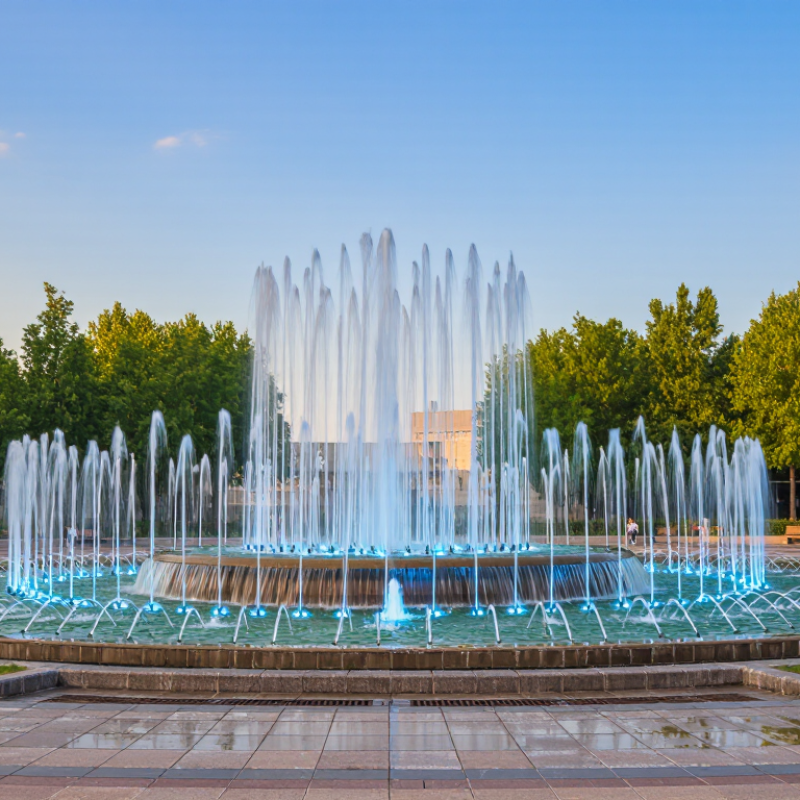
Define the Project’s Site, Purpose, and Performance Goals
How to Choose an Outdoor Musical Fountain for Your Project
Choosing an outdoor musical fountain starts with the site, not the equipment catalog. Measure wind exposure, viewing distances, sunlight, drainage, and nearby residences. A plaza facing prevailing wind may need lower jets and stronger splash control. A hotel entrance may value quiet choreography, while a civic square needs reach, rhythm, and visibility across 30 meters. Record ambient sound during busy and quiet hours. It changes the specification.
The project’s purpose should be written in observable terms. Is the fountain a landmark, cooling feature, event backdrop, or daily public amenity? Each purpose changes nozzle height, program length, lighting, and maintenance access. The ASHRAE Handbook—HVAC Applications identifies evaporation, wind, and splash as important water-loss factors. The U.S. Environmental Protection Agency estimates household leaks waste nearly one trillion gallons yearly nationwide. A recirculating fountain still needs disciplined makeup-water planning. Water is not free.
Set performance goals before requesting quotations. Define acceptable sound levels, water clarity, restart time, uptime, energy use, and winterization requirements. Ask for pump curves at the actual total dynamic head, not maximum flow. Require measured throw heights under realistic wind conditions. A dramatic indoor test can mislead. The 2024 UN World Water Development Report states that 2.2 billion people lacked safely managed drinking water in 2022. That figure should influence filtration, leak detection, and refill strategies. I have seen attractive basins fail because maintenance was treated as an afterthought. That assumption is often wrong.
How to Choose an Outdoor Musical Fountain for Your Project - Define the Project’s Site, Purpose, and Performance Goals
| Project Dimension | Site Conditions to Define | Project Purpose | Recommended Performance Goals | Key Planning Checks |
|---|---|---|---|---|
| Available Footprint | Measure the usable length and width of the basin, plaza, or open-water area. Record setbacks from buildings, walkways, trees, and underground utilities. | Create a focal point without obstructing circulation, emergency access, views, or public seating. | Layout Keep equipment, maintenance access, and spectator areas within the planned site boundary. Use a smaller spray pattern for compact plazas and a wider pattern for open parks. | Confirm a scaled site survey, drainage route, access path, construction clearance, and safe separation from electrical equipment. |
| Water Depth and Basin Geometry | Document water depth, basin shape, floor level changes, overflow points, and the location of pumps, lights, nozzles, and underwater cables. | Support stable fountain operation while reducing splash outside the basin. | Water Control Use nozzle heights and spray angles that suit the basin depth and perimeter. Design overflow capacity for the maximum operating water volume and rainfall conditions. | Check structural loading, waterproofing, water-level sensors, filtration, make-up water, drainage, and access for cleaning. |
| Wind Exposure | Assess prevailing wind direction, seasonal gusts, nearby towers, open coastlines, large roofs, and surrounding trees or buildings. | Maintain a clear visual show and limit wetting of adjacent paths, roads, façades, and electrical areas. | Reliability Specify wind monitoring and automatic height reduction or shutdown. Use lower or more stable effects in exposed locations. | Review local wind data, splash modeling, wind sensors, restart settings, and a safe operating procedure for severe weather. |
| Audience Distance and Viewing Angles | Map principal viewing zones, pedestrian routes, seating, terraces, nearby roads, and accessible viewing locations. | Make the show visible and engaging from the intended audience areas. | Visibility Coordinate spray height, lighting beam angles, color changes, and choreography timing for both close and distant viewers. | Test visibility in daylight and darkness. Avoid glare, blocked sightlines, slippery surfaces, and spray crossing public routes. |
| Musical and Themed Content | Identify whether the project is intended for short programmed shows, daily background ambience, celebrations, or seasonal events. | Match the fountain’s visual language and control system to the desired visitor experience. | Programming Define show duration, number of scenes, music sources, synchronization accuracy, content update method, and manual override capability. | Confirm audio licensing requirements, file formats, playback equipment, time scheduling, backup control, and content-management access. |
| Sound Environment | Record nearby residences, hotels, offices, schools, hospitals, restaurants, and traffic noise during representative periods. | Provide clear music and announcements without creating an unacceptable disturbance. | Acoustics Set measurable sound limits at property boundaries and sensitive receivers. Use directional speakers, zoning, and volume schedules where appropriate. | Check local noise regulations, nighttime restrictions, speaker placement, sound reflections, and an acoustic commissioning test. |
| Lighting and Nighttime Appearance | Consider ambient light, surrounding façades, sky visibility, security lighting, viewing distance, and nearby transport routes. | Extend attraction after dark while supporting safety and visual comfort. | Visual Impact Use programmable underwater lighting with smooth dimming, timed scenes, and brightness levels appropriate to the surrounding environment. | Assess glare, light spill, underwater visibility, color consistency, energy use, waterproof ratings, and safe service access. |
| Water Quality and Climate | Evaluate temperature range, rainfall, evaporation, dust, leaves, algae risk, water hardness, and the availability of treated or recycled water. | Protect pumps, nozzles, lighting, and public health while maintaining clear water. | Water Management Define filtration, circulation, disinfection, dosing, water testing, seasonal draining, and freeze or heat protection requirements. | Follow applicable water-quality and public-health rules. Include a cleaning schedule, chemical storage controls, and safe maintenance procedures. |
| Electrical Capacity | Confirm available voltage, supply capacity, cable routes, control-room location, grounding, and distance between dry and wet equipment. | Deliver reliable pump, lighting, audio, control, and safety-system operation. | Power Size the supply for the maximum simultaneous load, startup current, control equipment, lighting scenes, and future expansion allowance. | Require residual-current protection, bonding, waterproof enclosures, lockable panels, emergency isolation, and inspection by qualified personnel. |
| Energy and Water Efficiency | Define operating hours, seasonal attendance, utility costs, water availability, and sustainability targets. | Control lifecycle costs while preserving the intended show quality. | Efficiency Use variable-speed pumping, scheduled operation, LED lighting, leak detection, efficient filtration, and reduced-output modes during low attendance. | Compare annual energy and water demand, maintenance costs, standby consumption, and expected replacement intervals. |
| Safety and Public Interaction | Identify access points, water edges, slippery surfaces, children’s areas, crowd density, and the distance to public electrical equipment. | Protect visitors, staff, performers, and service personnel during normal and abnormal conditions. | Safety Provide barriers or edge treatments where needed, emergency stop controls, level and flow monitoring, non-slip surfaces, and clearly defined restricted zones. | Complete risk assessments for water, electricity, slips, access, crowd movement, chemicals, noise, and weather-related shutdowns. |
| Maintenance and Service Access | Plan routes for technicians, lifting equipment, replacement parts, drainage, filter cleaning, and safe access to submerged components. | Keep the fountain available and reduce downtime over its operating life. | Maintainability Specify accessible pump chambers, removable strainers, isolation valves, inspection points, spare nozzles, and clear service documentation. | Set inspection frequency, cleaning intervals, response times, spare-parts requirements, staff training, and seasonal shutdown procedures. |
| Schedule and Operating Pattern | Define construction deadlines, opening dates, peak seasons, daily show times, special events, and required commissioning periods. | Coordinate installation and programming with the project’s public opening and event calendar. | Delivery Allow time for hydraulic balancing, lighting focus, audio tuning, safety testing, water treatment setup, and full-show rehearsals. | Create milestones for design approval, permits, procurement, installation, dry testing, wet testing, training, and handover. |
| Budget and Lifecycle Value | Separate costs for civil works, basin construction, pumps, nozzles, lighting, audio, controls, water treatment, utilities, staffing, and maintenance. | Choose a system that meets the experience goals without creating unsustainable operating costs. | Value Compare initial cost, annual energy and water use, cleaning labor, replacement parts, software support, warranties, and expected service life. | Use a lifecycle-cost review rather than comparing purchase price alone. Include contingency for site conditions and future repairs. |
Planning principle: Select the musical fountain only after the site constraints, visitor purpose, operating schedule, safety requirements, and measurable performance goals have been defined.