

7 Tips for Choosing the Best Night Stand With Legs

A bedside table looks simple until it has to fit a narrow walkway, hold a reading lamp, and keep a phone within reach. A Night Stand With Legs can make a small bedroom feel lighter, but the wrong height or unstable frame quickly becomes annoying. Small details matter. Measure the mattress height, available floor space, and items you actually use before choosing a style.

Industry data offers useful context, though it cannot identify one perfect nightstand. The 2024 Houzz & Home Study reported a median U.S. renovation spend of $24,000 in 2023, underscoring how home purchases sit within larger investment decisions. The U.S. Census Bureau’s Monthly Retail Trade Survey also tracks furniture and home-furnishings sales. Neither report rates individual bedside tables, so treat market figures as background—not proof that a product is durable or right for your room.

These seven tips focus on checks you can make yourself: matching table height to the mattress, assessing leg stability, checking drawer space, and considering materials and cleaning needs. Look closely at joints and hardware; a polished product photo cannot show how a drawer feels after months of use. And yes, style can distract. I would reconsider any choice that looks beautiful but blocks a door or leaves no room for a glass of water. Use measurements, product specifications, and verified reviews together, while remembering that reviews reflect individual experiences.
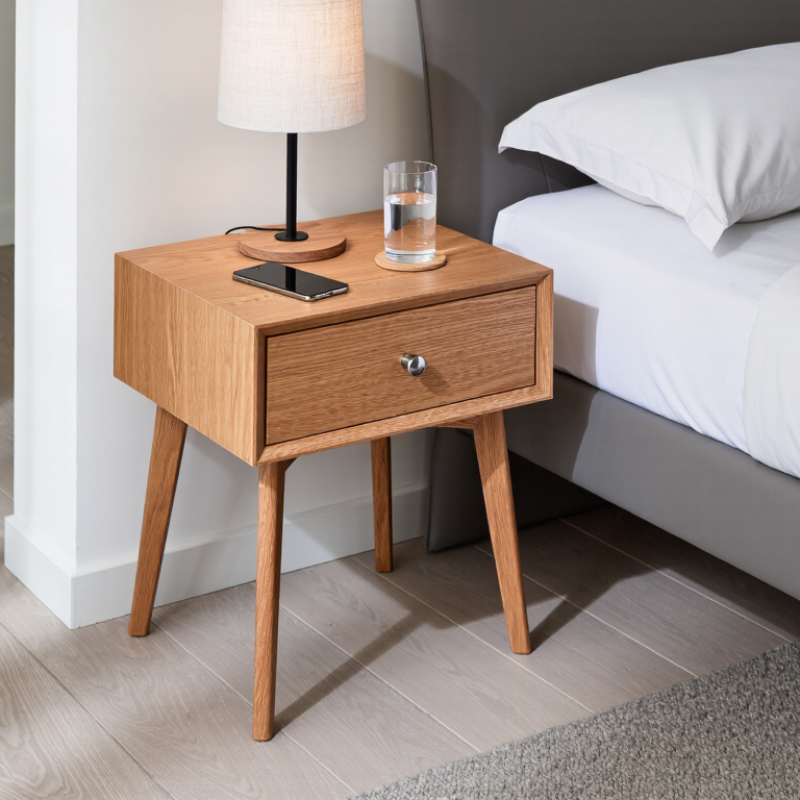
7 Tips for Choosing the Best Night Stand With Legs

Match Nightstand Height to Mattress Level Within a 2-Inch Range

Measure from the floor to the top of your mattress, not to the bed frame. Aim for a nightstand surface within two inches of that level. Your phone, water glass, and reading lamp should be reachable without a deep bend or an awkward shoulder stretch. Small detail. Big difference at 2 a.m.

The Sleep Foundation’s mattress-height guide notes that mattresses commonly range from 8 to 14 inches thick. That six-inch spread can shift your bedside reach more than expected, especially when a tall foundation or plush topper is involved. Measure the bed as it is actually used, with bedding and topper in place. Then compare that number with the nightstand’s tabletop height, not its listed overall height.

Check the fit while standing beside the bed, then try reaching from your usual sleeping position. Your arm should move naturally; you should not have to lean across the mattress. A two-inch range is a practical target, not a medical standard, and personal mobility matters. I’d recheck after changing a mattress or base—easy to forget, and it can make yesterday’s comfortable setup feel oddly out of reach.

7 Tips for Choosing the Best Night Stand With Legs - Match Nightstand Height to Mattress Level Within a 2-Inch Range

Tip What to Check Practical Guidance Example
1. Match the top to mattress height Measure from the floor to the top of the mattress, including the bed base or foundation. Choose a nightstand whose top is within 2 inches above or below the mattress surface for convenient reach. For a 25-inch mattress height, look for a nightstand with a top between 23 and 27 inches.
2. Measure your bed after setup Check the fully assembled bed with the mattress and bedding in place. Bed frames, foundations, and mattress thicknesses affect the final height. Measure the actual setup rather than relying only on product dimensions. If the mattress top is 28 inches from the floor, the suggested nightstand-top range is 26–30 inches.
3. Check tabletop width Compare the nightstand width with the space beside the bed and the items you keep within reach. Allow enough room for essentials such as a lamp, phone, or glass of water, while leaving clear walking space. A 20-inch-wide table may suit a compact bedside area; measure the available gap before buying.
4. Consider leg height and floor clearance Look at the space between the floor and the underside of the nightstand. Make sure the legs fit around baseboards and that the clearance works with your cleaning method or floor-cleaning equipment. Measure from the floor to the lowest part of the table, not just to the bottom of the drawer.
5. Check stability and leg construction Inspect how the legs attach and whether the table sits level on your floor. A firm, level table is safer for lamps and other bedside items. Adjustable feet can help on slightly uneven floors. After assembly, gently test for wobbling and tighten the fasteners if needed.
6. Choose storage for your routine Decide whether you need an open shelf, a drawer, or a combination. Open shelves keep frequently used items accessible; drawers can help keep smaller items out of sight. Check the drawer opening space beside the bed. Measure the distance from the table to the bed so a drawer can open without obstruction.
7. Confirm the full footprint Measure the tabletop, leg positions, and any overhang or hardware. Use the widest dimensions when checking fit, and leave enough room for bedside access and nearby doors or drawers. Mark the table’s width and depth on the floor with removable tape before placing an order.

Plan Walkway Clearance Using the ADA’s 36-Inch Accessible-Route Benchmark

When choosing a night stand with legs, measure the walking route beside the bed before shopping. The ADA’s 36-inch accessible-route benchmark is a useful planning reference, not a universal bedroom requirement. Measure the narrowest clear space between the bed, wall, and other furniture. Include anything that sticks out, such as a drawer pull or lamp cord. Small details matter.

Tips: Leave about 36 inches where practical; check clearance with drawers open; choose a compact top; look for sturdy legs that do not jut outward; keep cords against the wall; test the route at night; and consider who uses the space. A tape measure helps. So does a real-life test: place a box where the stand would go, then walk past it carrying a laundry basket. I once underestimated a drawer’s reach. It changed the whole layout.

A clear route can make a room easier to navigate, especially for someone using a mobility aid or moving around in low light. Still, bedroom layouts vary, and a smaller room may not allow a full 36 inches. Prioritize an unobstructed path, stable furniture, and enough space to reach the bed safely. Check the fit before assembly.

Compare Nightstand Footprints with Common 18–24-Inch Widths

An 18-inch nightstand suits a tight bedside zone, while 24 inches offers more room for a lamp and a glass of water. Compare both widths against your bed, not just the wall. The International Sleep Products Association lists a queen mattress as 60 by 80 inches. With one stand on each side, the combined bed-and-table width becomes 96 inches with 18-inch tables, or 108 inches with 24-inch tables. That difference matters in narrow rooms. Measure the clear space between the bed and the opposite wall, too.

Use painter’s tape to mark each footprint on the floor. Open drawers and walk past the taped edges. A table can fit on paper but block a closet door in real life. Check its height against the mattress top; reaching down for a phone gets old quickly. Also note the legs’ placement. Splayed legs may extend beyond the tabletop and catch a toe. I still find floor plans easy to misread. A tape measure is less forgiving, and more useful. For broader context, the U.S. Census Bureau’s American Community Survey tracks room counts, but not bedside clearances, so your own measurements should guide the final choice.

Check Stability Test Reports Against ANSI/BIFMA X5.5 Table Criteria

A nightstand can look solid yet rock when a drawer is pulled. Ask for a laboratory stability report referencing ANSI/BIFMA X5.5, the standard for desk and table products. Check that the report names the tested model, standard edition, setup, and results—not merely “passed.” It should describe the stability procedure and any relevant strength or durability tests. Confirm that the tested configuration matches your table, including its legs, drawers, and assembly.

The U.S. Consumer Product Safety Commission’s 2023 tip-over report estimated an annual average of 22,500 emergency-department-treated injuries from tip-overs during 2020–2022. That figure covers furniture, televisions, and appliances, not nightstands alone. Still, it shows why a stability result matters. Look for test conditions that reflect use: drawers loaded, the floor level, and the unit assembled as instructed. Ask whether the lab recorded movement or tipping under the specified test force. A pass mark without those details is hard to judge. Small details matter. I would also check the legs for loose joints after assembly; a formal report cannot guarantee every home floor is flat.

Evaluate Wood-Panel Durability Using ASTM D1037 Test Measures

A nightstand with slim legs can look light, yet its panels carry the drawer, lamp, and daily clutter. ASTM D1037 provides test methods for wood-based fiber and particle panels. Useful results include bending stiffness and strength, internal bond strength, screw withdrawal, and thickness swelling after water exposure. These measurements help reveal whether a panel may flex, split around fasteners, or swell when exposed to a spill. That matters.

Ask for a test report tied to the actual panel type and thickness used in the nightstand. Check the reported values, specimen conditioning, and test method—not just a claim that the material was tested. ASTM D1037 describes how to measure properties; it does not set one universal pass mark for every bedside table. A strong panel result also cannot guarantee a sturdy assembled piece. Leg attachment, drawer weight, joint design, and floor contact affect real-world stability. I would check those details in person when possible: press gently on a corner, inspect the fasteners, and look for uneven gaps. It is easy to overlook how a small wobble grows annoying beside a bed. Test data is helpful, but it is not the whole story.

7 Tips for Choosing the Best Night Stand With Legs

Evaluate wood-panel durability using ASTM D1037 test measures.

How to read this chart: Moisture content is calculated as water mass divided by oven-dry mass, multiplied by 100. The bars show the corresponding water mass for a 100 g oven-dry specimen; they are calculated examples, not measured panel results or ASTM acceptance limits. When comparing nightstands, ask for relevant ASTM D1037 results such as screw-holding capacity, bending strength, and thickness swelling. Compare results for similar panel types and thicknesses.